poetteacherperformerscientistecologistwarpoet - home
science
"A major exponent of public art, authentic performance and hybrid forms, particularly science in poetry." - Poetry Bites
"Contemporary poets such as Ruth Padel and Mario Petrucci, who has a PhD in laser-optic materials, showed me that the concerns and practices
of poetry and science are still closely linked. Like the scientist-poets of the nineteenth century, these writers use their verse to test out
hypotheses about the origins of life, and to examine the philosophical implications of scientific theories." - Gregory Tate, BBC Radio 3 New Generation Thinker
"A true polymath, blending disciplines to exultant and exalting effect, finding poetry in science and applying the rigours of science
to a poetry that brings the heart in the mind pulsing on to the page." - PBS Bulletin, Spring 2010
"Mario enabled all involved to strike up a fascinating dialogue between science and poetry... I also found the experience
of working with Mario to be excellent, and I have learned examples of good practice that will inform any future collaborations." - Miriam Valencia, Southbank Centre/ The Royal Society 'Poetry and Science' Residency 2010 ...click here for full Testimonial
"Concretion, avidity, are signs of the poetic master but also of the scientist that Petrucci is...
These crucial touches of the concrete are what Petrucci is so good at." - Stride magazine, 2010
TIME IN SCIENCE is Petrucci's script for an ingenious and mesmerising audiovisual scientific collaboration (entitled Conversation on Time)
exploring the metaphysics and temporality of big data, particularly with regard to its impact on modern consciousness.
[Video created/coordinated by Maria Rebecca Ballestra; commissioned by the JRC SciArt Programme and the Resonances III 'Big Data' Datami Festival (Ispra, 2019).]
For the audio of the poem (without visuals or music, etc.) recorded by the author... click here.
For the project/context surrounding the collaboration... click here.
To read the entire text of the poem Time In Science as composed by Petrucci... click here.
To watch the archived YouTube video for the COMPLETED FILM as presented at the Festival, click the thumbnail to the right...
**************************************************************************************************************************************************************** STOP PRESS! SPACE POETRY, 2015/16...
PHILAE - this space poem, composed by Petrucci, is taken up by the European Space Agency (ESA)
[click here] to mark its inspirational comet landing...
Petrucci writes: "Before reincarnating [in this lifetime] as a poet and educator, I was a full-blown physicist. So, scientific projects like the Rosetta/Philae mission resonate profoundly with me and my writing.
Please bear in mind, when you first read [or hear] the Philae poem, that it's a modern work - it doesn't consist of easy-going romantic statements! It looks, instead, for depth, richness, a powerfully layered complexity,
and a touch of strangeness that isn't out of place in deep space. The poem paints again, with words, the astonishing images that we've seen from the mission; but it also strives to raise many of the subtle human
and cosmic meanings associated with this historic undertaking. The text refers, for instance, to the famous Rosetta Stone, and to the original 'Philae' - the island[s] and ancient temples submerged by the Aswan Dam.
Perhaps the poem is best summed up, though, by the response it drew from the outreach team at the ESA: 'The images in this poem are so strong and yet so precise... and while it transpires
that the poet was deeply touched by the technical achievement of the comet landing, there is so much in the poem about us as humans, our aspirations, our weaknesses, our dreams.'
If Philae is that plucky little gnat on the back of its huge grey elephant, then this poem - in its own way - is a tiny voyager riding the vast and equally mysterious limits of language."
To listen to the poem, click here...
To read Philae on the University of Liverpool Literature and Science Hub, click here;
also for 'Fuzzy Richness', an interview on science & poetry with Mario on that same site, click here.
****************************************************************************************************************************************************************
Writing ↔ Science Project
sponsored by the Royal Literary Fund
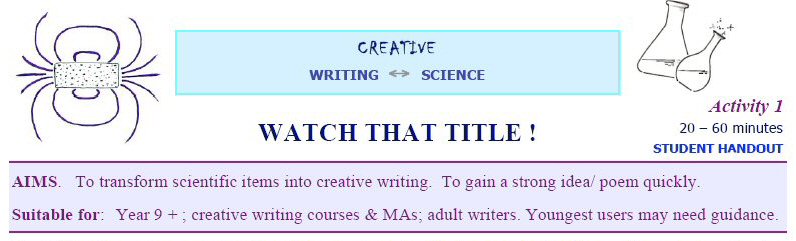
Resource 1: Click here for 'Creative Writing ↔ Science' An innovative pack of creative writing exercises involving science
Click for Mario's poem, Plutonium [or here] - plus his interview(reproduced below) - on the Poetry and Science website.
Warwick Writing Programme (George Ttoouli) - Combining Poetry and Science as Equals: Click here
"Raw scientific poetry, the point where embellishment falls away and science = poetry, a = b; the one becomes a metaphor for the other".
Southbank Centre/ the Royal Society 2010: 'See Further' residency/commission (Festival of Science and Arts). For resulting school resource The Poetry Box, see teaching page.
'Literature and the Sciences: Where do they meet?': Mario's talk at the London School of Economics - click here for [transcript] or [audio]
Wellcome Foundation: 'The Poetry of Science'
[Poet in the City, July 2007]
[or click here for video in New Scientist archive]
EXAMPLES OF MARIO'S RESEARCH WORK WITH CRYSTALS & ELECTRONS
Mario has a Cambridge degree in Physics, a PhD in laser-optic materials [Univ. College London] and a BA in Environment
& Society from Middlesex University, where he was course organiser/lecturer in Environmental Studies.
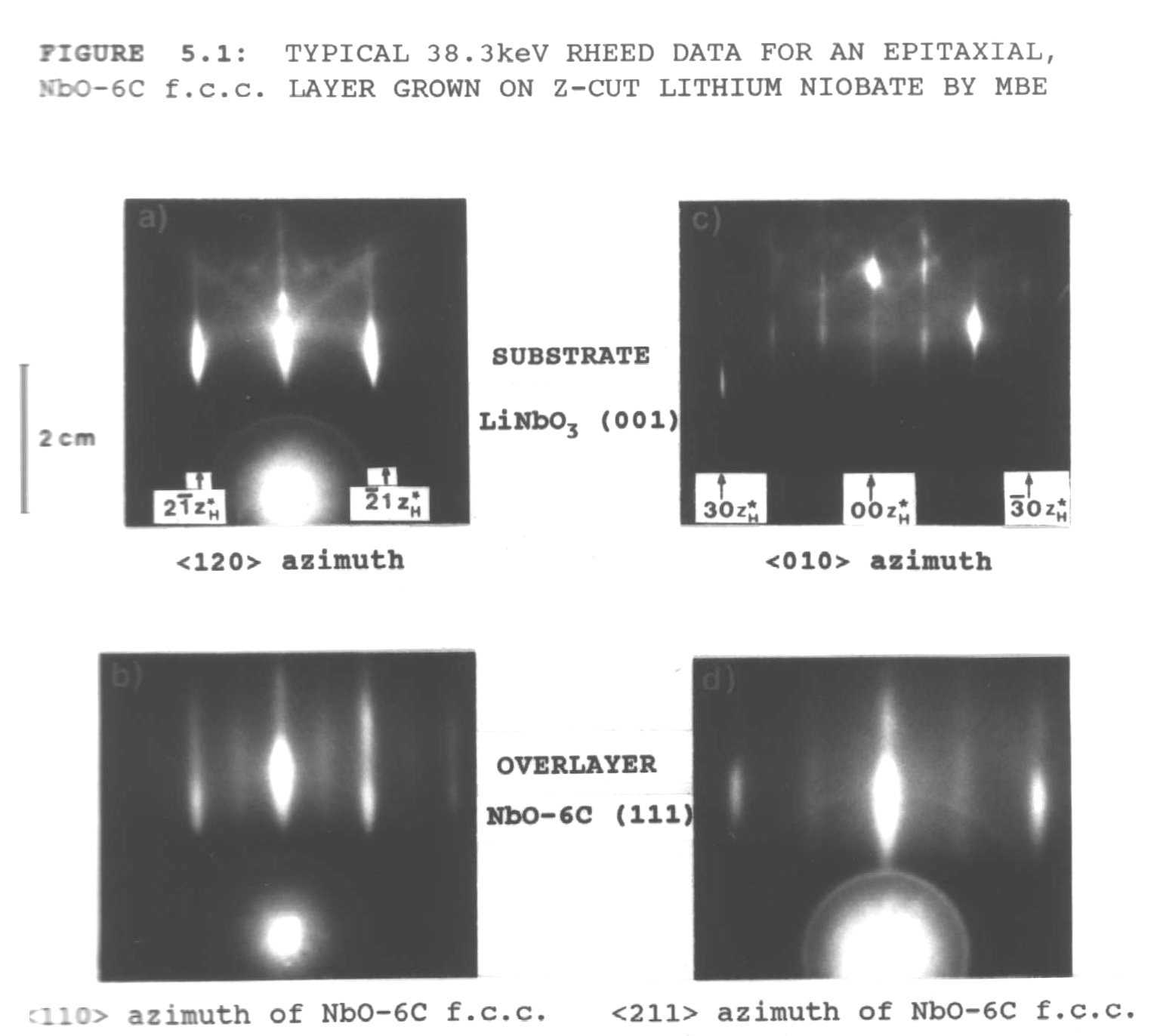
Mario's original work in experimental physics at UCL involved the growth of new electro-optic crystals deposited
in ultra-high vacuum, and their exploration using high-energy electron diffraction and x-ray analysis
[click for a pdf of his PhD].
********************************************************************************
[ Interview for the Centre for Poetry and Science ]
'Pheromones and poems'
The fact that I'm an ecologist, as well as a ‘lapsed physicist', might explain why I'm forever delving into the interfaces between poetry and other disciplines. In growth, interfaces are everything. A potato plant can sprout from peelings, but never from that starchy bulk we tend to focus on as food. Interfaces hold the key - or at least the imprint of the key - to grappling with the tragedies and opportunities of what is (for those in the privileged North) a fast, interwoven, techno-social world.
Science and Poetry? Well, poetry certainly has a lot to do with anatomy. It's easy to forget how its sound is launched from flaps of skin in the throat, that it is a sustained, modulated vibration of a gaseous fluid. I love the idea that the most intense experiences of poetry can be pheromonal, filling a room with the sweet, subliminal scent of aroused communication. When that happens, audiences help to make the poem. Their response can become an organic hologram within you, storing in your bones (and in your ear) the shape and smack of genuine human interaction. A poem is shared breath. After all, it both shapes - and is shaped by - breath. If inspiration is the breath in, then the poem is the breath out. It is somatic as well as intellectual. It has to be tested out on your personalised drum-kit of inner ear.
Talking of inspiration, I'm an idiot Benjamin Franklin forever launching my kite into the cloudless blue (and, too often, holding my breath as I do so!). Those internal processes of composition often seem inexorably meteorological - a kind of spontaneous condensation in the dark interstices of consciousness. The poem: a thick vapour that creeps under the door of your brightly lit life, demanding that you investigate and experiment. The rest is trying to get the blasted door to open. But, as when I was a physicist, I thrive on unexpected results. During one of my classroom visits, for example, after asking a class to invent a futuristic voice, a disgruntled student raised a heavily-ringed hand and (with a face brimming with Anglo-Saxon feeling) encouraged me (shall we say, euphemistically) to ‘do' my own exercise. I did; and the resulting poem (entitled Gene) helped me towards a new voice. Angels often come disguised as devils.
Since my first book, Shrapnel and Sheets, I've been trying to gauge, and span, the supposed arts-science duality. I've been keen to write poems that move the listener, yet address the problems and possibilities of technology; that encapsulate individual corpuscles of scientific perception whilst sending ‘waves' through an audience with their performance and resonance. I believe science and poetry can successfully co-exist in this way, but not through the injection of science into poems in an arbitrary manner, or as a kind of technological name-dropping. The science has to be fully absorbed into the creative writing process, so that the poems achieve a negotiated co-habitation, an organic balance. That was my intention with the book-length poem/ sequence on Chernobyl, Heavy Water (Enitharmon, 2004) and my current (July 2007) collection with Enitharmon, Flowers of Sulphur.
I try, however, not to obsess over technology or our eco-social sins. History (say) can be just as important. Indeed, the media (and our entertainment culture more generally) seem so focused on topicality and the present, I'm concerned for the past's future... But, yes, I do keep an on-going eye on science. Science inspires me because I experienced it at the coal face; but also because I've found that the rigour and precision of the scientist is not foreign to the poet, just as the faith-leaps of poetry are far from excluded from the drawing-boards of science. Poetry and science do not resemble tribal arch-rivals, but kissing cousins. They both ask deeper questions of what is superficially observed and, by the same token, both adopt a hypothetical and provisional stance towards what they try to understand. They each demand that we pay full, plural attention. And, as someone versed in quantum physics, I'm fascinated by metaphor, the way everything (as in the quantum world) can become everything else. That's the engine-room of my writing, one of its major subjects.
Finally, science provides not just interesting things to write about; it also feeds one of my key creative concerns: to discover novel perspectives, new ways of perceiving and processing ‘ordinary' experience. As that prolific writer, Anonymous, has said: a physicist is the atom's way of thinking about atoms. Perhaps, then, a poet is the poem's way of thinking about words.
[Afterthought: the quote from 'Anonymous' at the end of the above piece is a variation of a statement made by Niels Bohr.]
"It might be that as science expands to occupy what can be scientifically explained, poetry enacts an equivalent expansion into what is imaginatively, humanly possible.
This is the yang and the yin, the Lingam-Yoni, between science and poetry. Just as one threatens/ offers to explain everything, the other offers/ threatens to blow it all open." Mario Petrucci
"It's now fashionable - especially among poets - to proclaim the everlasting marriage of science and poetry. Well, the theoretical and empirical sciences do often deploy metaphor and imaginative exploration,
or embrace the many-voicedness of partial data... but applied science tends to concern itself with the elimination of doubt and the unexpected, which it perceives as 'error'. Practical science strives to reduce its experiences to a single, desired, reproducible set of outcomes.
'Applied poetry', however, opens up possibility, is often all about multiple, plural, contradictory consciousness and fruitful incommensurability. It seems to me that the notion, or ideal, of utter scientific objectivity is not only antithetical to the subjectivity inherent in poetry,
it has also been revealed as somewhat suspect (even if you contest the idea that science is, to some degree, socially constructed, quantum physics itself demonstrates that the universe embodies 'subjectivity' in the sense that the observer is always implicated in what is observed).
That's not to say that poetry and science can't overlap and converse; of course they can, in all kinds of ways. It's far from coincidental, for instance, that relativity, quantum mechanics, cubism and literary modernism emerged roughly contemporaneously.
My point is that the commonalities of poetry and science need to be properly thought through, that their respective discourses need to be respectfully differentiated and never glossed over or made glib in the cause of an appealing superficial unity." Mario Petrucci, April 2010 (edited Nov. 2014)
"Literature provides one means by which society can engage with the various strangenesses science throws up:
those new objects, ideas and situations for which we have no popular imagery (nor genetic instinct, for that matter),
whose metaphorical space is tabula rasa. Maiden knowledge or experience brings with it this crisis of representation.
Scientists and artists deal with metaphor on a routine basis – we need their metaphors to help us explain, experience
and explore the unprecedented, whether it’s a scientific breakthrough, nuclear fallout, or 9/11." Mario Petrucci (Acumen 59)
"The very nature of 'metaphor', so crucial and central to poetry, is not altogether unrelated to the essence of quantum physics - that everything can become [or might one say, is] everything else.
Indeed, it seems to me that the cosmos implicates all its parts in the whole and the whole in all its parts, which is effectively what poetry does with language. Perhaps the universe is, along with all literary endeavour across the ages, one giant hologram." Mario Petrucci
Creative writing workshops... POETRY ↔ SCIENCE.
First delivered as a Poetry School 10-week course, 2024 [now also available to other venues as a one-off workshop, 2024 onwards.]
"The gleaming wings of science." Winston Churchill. / /
What, really, is a 'science poem'? Better still, what can it be coaxed into, so as to galvanise and enrich our preferred subjects? Can those complex force lines of scientific knowledge be made to percolate and invigorate our work, simply? Is science being used predictably to engender earthbound poetic clones, or can its DNA mutate our poems towards flight? / /
This fascinating, hands-on, 10-week course investigates the many ways of amalgamating science and poetry. Amazingly, no scientific expertise is required for you to fully benefit! Mario Petrucci's ideas on how to utilise science in/as poetry simply don't exist anywhere else; as a practising physicist and ecologist who has won major literary awards with his science/ecology poems, he has devised an original and inventive set of perspectives and methodologies to guide you on a unique journey. / /
The course is principally a dynamo for new work that incorporates science interestingly, provocatively, and productively. You won't be writing 'about' science, which can sometimes lead to fad subjects like Black Holes; rather, you'll engage with the far less predictable activity of enlivening and informing your compositional practice through a variety of scientific processes. These processes provide a laboratory of fresh techniques, test-tubes and accidents (yes, accidents!) that can animate any subject, however light or profound, including your more personal, confessional work. You might even discover subjects you didn't know existed. / /
Largely practical in approach, the course centres on composition and workshopping. Each session, you'll be set a writing exercise as ‘homework’, which you bring to the following session for group feedback. Interspersed with this will be tutor-led teaching, sample 'science poems' for study and debate, and quotes/texts as prompts for group discussion. The atmosphere will be inclusive and open, with an emphasis on enjoyment and exploration, but full of surprises, maybe even the odd illuminating explosion!
P.S. Here's one surprise: the apparently positive Churchill quote I opened with was actually used by him in a cautionary context!
Mario Petrucci is a multi-award-winning poet as well as a trained ecologist and PhD physicist. As one of the UK's original 'ecopoets', he is respected internationally for his literary, educational and research contributions to the poetics of science/ecology. His commissions at major scientific institutions include the Royal College of Surgeons of England, the European Space Agency, the Wellcome Foundation, and the Natural History Museum. His prodigious corpus (more than 20 collections) incorporates science/ecology naturally and innovatively. With three decades of international creative writing teaching behind him, Mario delivers a course of immense variety and enduring value.
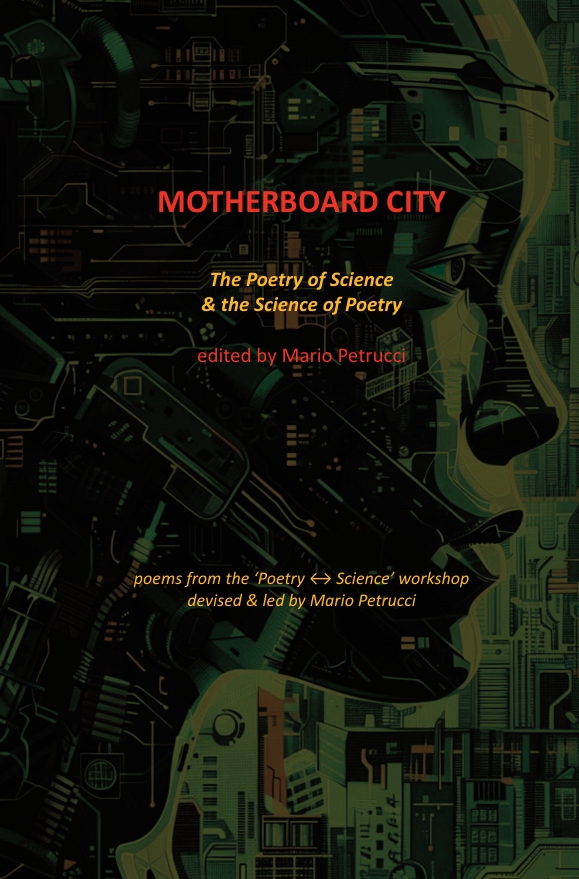
Fair Acre publishes (2025) anthology -
Mario devised & led this unique POETRY ↔ SCIENCE workshop & compiled/edited the fascinating results.
Poetry and Bio-medicine collaboration/commission [2013]: the MRC Laboratory for Molecular Cell Biology, UCL Poetry and Astrobiology: Mario constellates some possible connections here Arts Council England: Poetry in Science writing project award The Ecopoetry Study Packs: major Poetry Society initiative (youth awareness via creative writing & study) - see Ecology page for links Sustainability and the Arts, British Council project [Spain] Poetry Films involving science/ecology: Amazonia at the Natural History Museum & Heavy Water: a film for Chernobyl Through the Door: archival collaboration commissioned by Archives for London & Poet in the City [Royal College of Surgeons, 2013-14]
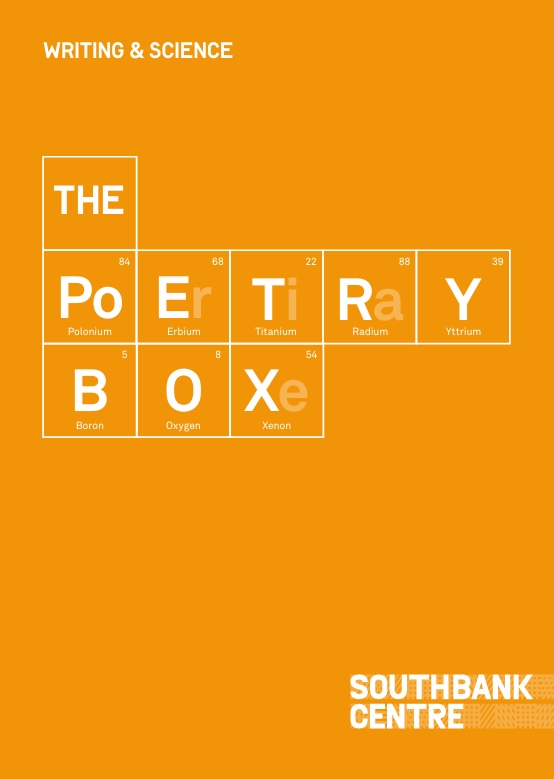
Read about Writing & Science: The Poetry Box[click here] (The Royal Society/ Southbank Centre) [OR view booklet HERE]
[See also ECOLOGY page for further science-oriented projects...]